About
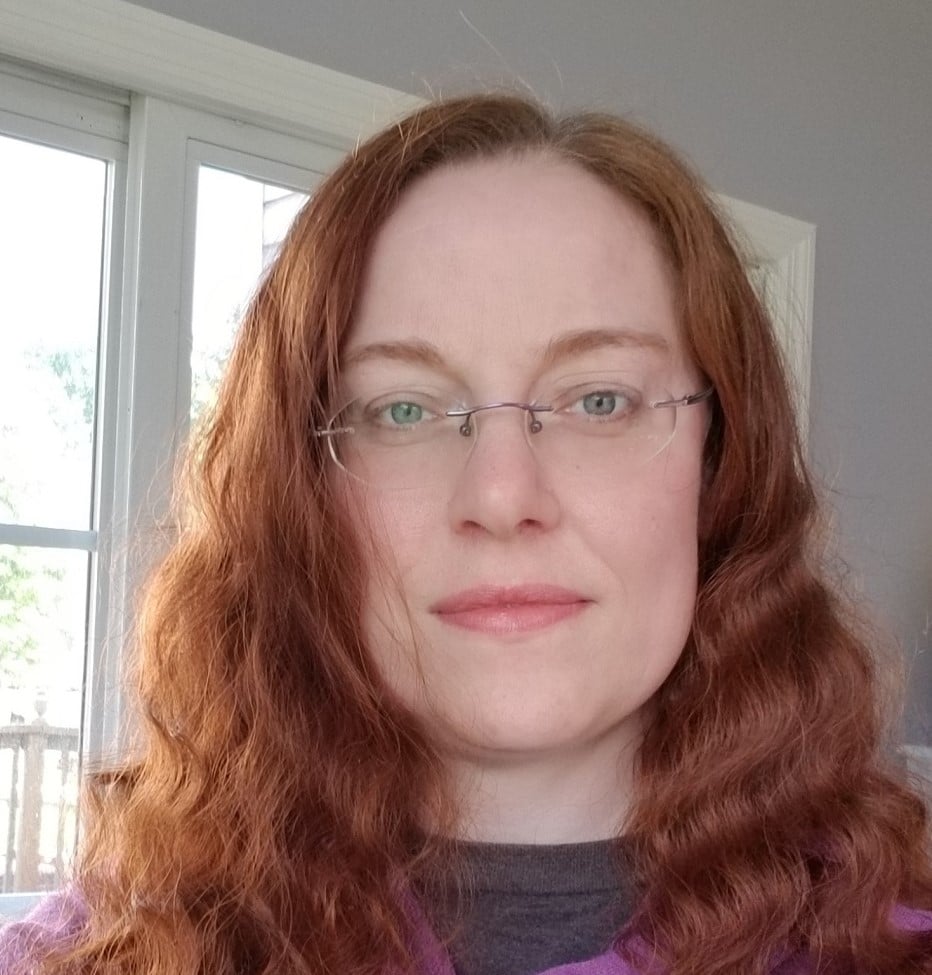
Welcome to my website!
Unless you got here by accident, you’re on this page because you want to know something about me and my writing, so here are the basics. I’m your classic introvert–-more interested in cozying up with my family, my pets, and my computer than going out on a Friday night. Yeah, I’m the one who quietly sits in the corner at a party (after I’ve been drug there kicking and screaming), drinks a little ginger ale, and doesn’t talk much. But writing? That’s totally different. The blank page is my favorite challenge-–it’s where my thoughts and ideas really come to life.
Christian Fantasy is my favorite genre as both a writer and a reader. There are enough graphic books and movies out there already, so I thought I’d do something different and write a wholesome series that families could enjoy together. You know, like stories and movies used to be. Clean doesn’t have to mean dumbed-down or over-simplified, and Christian doesn’t have to mean “preachy.” My stories are layered with meaning and real three-dimensional characters that people can connect with and relate to. They love, they laugh, they struggle, and sometimes they fail, but they always get back up to try again…just like we do. I’ve put a lot of effort and research into making their world feel just as real as they are. Fair warning, though. Once you go there, you might not be eager to leave again.
If you haven’t read my series yet, I hope you’ll try it out. The very first book, Journey to Aviad, is free everywhere in ebook format. You can get the second one free too by subscribing to my author newsletter.
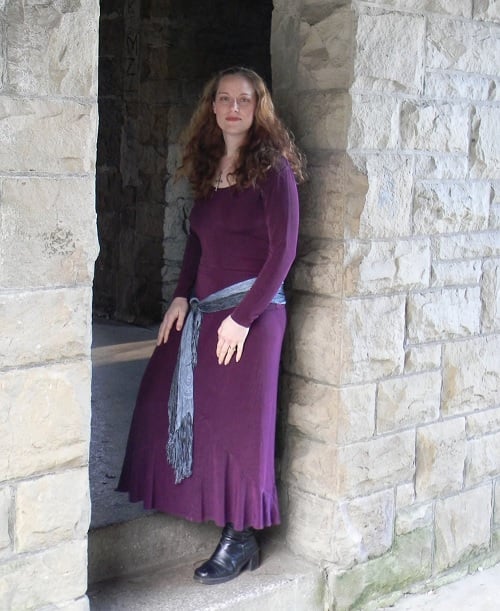
Author Bio
Allison D. Reid was born in Cincinnati, Ohio. Her love for medieval fantasy was sparked by the Narnia Chronicles by C.S. Lewis, which fed both her imagination and her spiritual development.
When at the age of thirteen her family moved to Germany, her passion for medieval history and legend only increased, and she found herself captivated by the ancient towns and castles of Europe.
Allison returned to the United States to study art and writing at Hampshire College in Amherst, MA. She earned her B.A. under the tutelage of the well-renowned and prolific writer Andrew Salkey, a student of her other great inspiration, and the father of fantasy, J. R. R. Tolkien. After graduating from Hampshire College, Allison moved to Connecticut. There she got the opportunity to attend seminary and further explore her faith before returning to her home state of Ohio.
Allison now lives in the Miami Valley area with her husband and children. She continues to work on her first published series while taking care of her family, editing for other independent writers, and managing a home business.
Questions from Past Interviews
Give us some insight into your main character. What does he/she do that is so special?
My two main characters are sisters, and they both have equally important roles in the story. Their abilities and personalities are complementary, and they need each other in order to survive on their own.
Morganne, the eldest, is studious, reflective, and focused. She demands a lot from herself, and doesn’t like to ask others for help. Her upbringing has placed a lot of responsibility on her shoulders. That has had a profound effect on the way she sees herself and the world around her. Even when her situation changes and she gains her freedom, there is an inner loneliness about her independence that remains with her into adulthood.
Elowyn is more of a free spirit. She is highly sensitive, empathetic, and observant; easily awed by beauty, but equally horrified by the suffering of others. She seeks solitude in the wilderness without ever feeling alone. Whereas Morganne’s faith is more intellectual, Elowyn is readily moved by the Spirit.
What was the hardest part about writing your latest book?
My latest book (Ancient Voices at the time of this interview) is more intense and introspective than Journey to Aviad. History, legend, and prophecy are starting to converge more rapidly. There are a lot of details to keep track of, and the underlying Christian message needs to stay true in spite of the unique way in which it unfolds in my imaginary world. Allegorical fiction gives me more leeway for creativity, but it also provides more opportunities for me to screw things up and say things that I don’t really intend to.
Another difficulty I’ve had is that Morganne and Elowyn are growing up. They live in a time and culture much different from our own, where the line between childhood and adulthood was pretty thin. While teens of our generation are thinking about school, extracurricular activities, and having fun, teens in the middle ages were already laboring at their adult jobs, getting married, and having families. Average life expectancies were about half of what we’re accustomed to. Girls could be married off as early as 12, and there was a much larger age difference between husbands and wives. Wrapping my head around all of that mentally has been challenging at times, and I’ve had to find ways to convey this shift in the norm (at least from our perspective) appropriately to my readers.
Where do your ideas come from?
A combination of experience, observation, history, and mythology. I tend to draw on all of those for inspiration when I am writing a fantasy work. Sometimes I want to get a particular message across, a feeling, or a moment. At other times I am drawn to the idea of a specific personality or an idea for a world.
What research did you have to do when writing your novel?
Even though my book is set in a fantasy world, I wanted to be as accurate as possible in my portrayal of daily medieval life. I did a lot of research on things like food, clothing, technology, beliefs, occupations, education, etc. One of my main characters is a seamstress. I had to research thoroughly how cloth and clothing were produced in that era. This was an especially interesting task for me since I can’t sew at all! At one point I actually bought a drop spindle, which was a common tool in most medieval households, just so that I could feel, see, and know what it was like. Amazingly, medieval women learned to make thread with their spindles while doing other household chores at the same time. My thread? Not so amazing. It came out lumpy in places and pulled apart in others. Still, it was good to get some hands-on research and the experience made me appreciate the skill it took to make fine thread without machinery. The other aspect of my research was theological in nature. Because the Wind Rider Chronicles have an underlying Christian message, I needed to be accurate in my presentation of core Christian beliefs.
For your own reading, do you prefer ebooks or traditional paper/hard back books?
I like both for different reasons. ebooks are so convenient to carry around. I can read them right from my android phone, which I always have with me anyway. They are cheaper (which means I can buy more of them) and they don’t take up space in my house. That being said, I look at a computer screen all day, whether I am working or writing. It is a refreshing change to read from something that doesn’t require batteries! Nothing replaces the experience of getting away from all the electronic distractions and curling up with a real book. Books that have significant meaning for me, or those that I know I will read over and over, I tend to buy in paper/hard back.
What would you say are the main advantages and disadvantages of self-publishing against being published or the other way around?
I put a lot of research and thought into my decision to self-publish. I came to realize that for the most part, traditional publishers no longer focus on promoting great writing, and discovering and showcasing new talent, but on producing what they consider to be easily “marketable.” Outdated methods, increased costs, and a changing economy have put publishers in the unfortunate position of having to be profit driven above all else. As a result, a lot of wonderful works continue to be passed up. Traditional publishers have also stopped offering the extensive editing and marketing services that once made them an attractive option for authors with limited resources, yet they still keep a majority of the profit from sales and sole rights to the author’s work.
E-publishing while not perfect, gives so many worthy writers who would otherwise face a lifetime of rejection letters, a voice and control over their own works. Admittedly there are a lot of ebooks out there that are not well written or edited, but the same can be said of some traditionally published works. I think the biggest struggle for self-publishing authors is figuring out how to effectively market their works. Obviously as individuals, we do not have the well-developed channels of distribution publishers do. But more and more I see indie authors supporting each other, and readers supporting their favorite indie authors. The resulting community has become a strong voice in the writing world that I don’t think is going away any time soon.
Is there a genre that you’ve been wanting to experiment with? If so, what is it and what attracts you to it?
I’ve been wanting to experiment with historical fiction for a long time. Aside from the Middle Ages, there are other eras of history I find fascinating, from ancient civilizations, through colonial times, to the industrial revolution and the Great Depression. What interests me most is the human element. I want to know what it was like to live during that time; how people thought, what they did, how they lived day-to-day, and how major events impacted them. As I’ve traced back my own family history, I’ve occasionally come across old photographs of my direct ancestors. In some cases, they are the most personal link I have amidst a handful of facts and official documents. Those eyes staring back at me are a haunting glimpse into a world I will never know, but that still connects through time to my present day existence. Writing historical fiction is a way to honor those who came before us, giving them a chance to live again–even if only in our imaginations–and touch a whole new generation of people.
Do you have a specific writing style?
An editor once told me that I have an older, more European writing style, and I guess that could be true. All I know is that I write from the heart, and I tend write visually. I see with my characters’ eyes, feel what they feel, smell what they smell, and try to write those experiences down in a way that allows my readers to do the same. Some readers demand instant, heart-pounding action or they lose interest. For me, every book is a journey. While there is plenty of action along the way, I tend to start a little more slowly, giving readers a chance to orient themselves and get to know their traveling companions. I want them to experience quiet beauty, joy, magic, and mystery in the midst of the twists and trials that make up an exciting plot.
Do you suffer from writers block?
Occasionally. But usually I find that I’m stuck because I’m emotionally, mentally, or even spiritually not ready to write the section I’m supposed to be working on. Even when I’m not writing, I’m constantly working things out in the back of my mind. When I’m finally ready, the words start flowing again, and I’m never disappointed that I waited. Some people say that you should just force yourself forward, and write even if you are uninspired. That doesn’t work for me at all. Patience and thoughtfulness usually serve me better, and result in a higher quality of writing even if it takes longer. While I’m waiting for my “writer’s block” to resolve itself, I work on other things; research, editing, character sketches, outlines, etc.
In your words, what defines a good story?
Real, three-dimensional, lovable characters are a must. A good story also has layers of meaning, so that you can read the same book more than once and catch different things each time. There should be an element of beauty and hope, but also plenty of mystery and suspense. I want to be moved by a story without being traumatized by it. I don’t deal well with dark, graphic, or tragic stories—they haunt me without mercy to the point where I wish I had never read them. The real world has enough trauma of its own!