 Easter is upon us once again, and with it always comes a profound longing that stirs me to examine myself, and my walk with Jesus, a bit more intently. There is something about going from the horror of the crucifixion, to the despair of waiting, to the elation of the resurrection, that brings a sense of renewal.
This is an unusual Easter for many, who would typically be preparing for a week of church services, and celebrations with friends and extended family. The need for social distancing and quarantine have forced us to forgo many of our annual Easter traditions. But maybe that’s not entirely a bad thing if we view this as an opportunity to grow. We can turn our forced solitude into a gift of time, during which we can slow down enough to contemplate the full depth and meaning of Easter. Maybe we can even start some new traditions.
 The most profound and memorable Easter I ever celebrated was not in a church. When I was a teenager living in Germany, I didn’t have a church, or even a Christian community to lean on. I had a Bible, a budding faith that was challenged and tested every single day, and a loving God who stood with me through all of it. One Easter Sunday I was invited by friends to take a hike in the grayness before sunrise. We ascended to the peak of a tall hill that had been entirely formed from massive piles of rubble leftover from WWII—a war in which my own grandfather had come overseas to fight.
 The hill was green and forested by the time I went there in the late 1980s. You never would have known it wasn’t a natural hillside until you got to the top, where the rubble seemed to burst forth from the ground, and you suddenly recognized massive pieces of wall, and columns, and sculpted stone adornments. The hill rises 1,000 feet above the Nekar River, and is made of 530 million cubic feet of historic debris—that’s the Empire State building 14 times over.
As I stood there on the highest point in all of Stuttgart, my mind struggled to fathom just how much destruction was piled beneath my feet, and how many millions of lives had been lost during the war. It was stunning, and incomprehensible. Words failed and silence fell over everything.
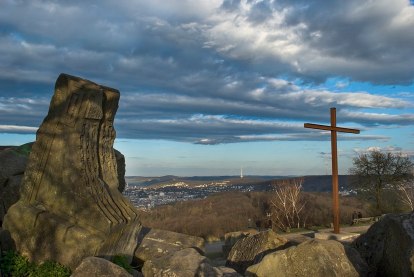 Rubble Hill, or Birkenkopf as it is also called, is one of those places that seems to demand quiet reflection. From it you can see everything on a clear day, even the distant Black Forest and the beginnings of the Alps. Erected at its top is a massive cross. The one that is there now is made of steel, but I was fortunate enough to see the original wooden cross that had been there since the 1950s. Standing on that hill on a chilly Easter morning, and singing hymns to the heavens while the sun rose to illuminate that cross, was an experience I will never forget.
We’re all like Rubble Hill in a way—sometimes broken and scarred by life’s trials, burdened by sins that we try to hide beneath attractive greenery, yet cannot fully contain. In victory over it all stands Christ, whose death on another wooden cross over 2,000 years ago set us free. He keeps vigil over our souls day by day because we now belong to Him, and He alone can transform all of our inner rubble into something beautiful beyond imagining.
So take some time in the quiet of this Easter morning to pray and reflect—maybe even sing hymns of praise as the sun rises. Take comfort in the words of Psalm 46 as we continue to endure these challenging times together.
“The Lord Almighty is with us; the God of Jacob is our fortress. Come and see what the Lord has done, the desolations he has brought on the earth. He makes wars cease to the ends of the earth. He breaks the bow and shatters the spear; he burns the shields with fire. He says, “Be still and know that I am God; I will be exalted among the nations, I will be exalted in the earth.” The Lord Almighty is with us; the God of Jacob is our fortress.”
Hope you all have a blessed Easter!



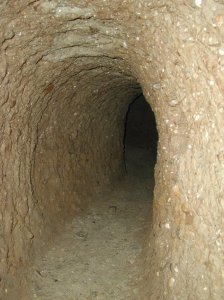
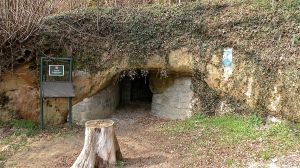 These tunnels are believed to have been constructed in the Middle Ages, but no one can figure out who built them, or why. And there aren’t just a few…over 2,000 tunnels have been discovered so far! They are smooth and rounded, carved right into the bare earth. They aren’t very large, only a few feet tall and wide. “Slip outs” are small holes that connect passages that are running at different elevations. Some of these are so tight, a person would have to literally squeeze through them to move from one tunnel to another.
 What are some of the theories? Some say they were used for storage. Not likely given they were small, dirty, wet, and difficult to get in and out of. Another theory is they were places where people hid from marauders. The small size of the tunnels, and lack of oxygen inside, would make this fairly impractical, too. Not to mention with only one way in and out, if their hiding place was ever discovered it would become a tomb rather than a way of escape. Some think the tunnels might have spiritual significance; a place for the souls of the deceased, or perhaps even dark spirits to dwell. Austrian folklore gives goblins the credit for their existence.
 I kind of wish I’d known about these erdstall tunnels when I lived in Germany so I could experience one for myself. In reality though, I’m horribly claustrophobic, so you’d have to practically kill me to get me in there. I’d no doubt peer with wonder into the small, dark entranceway, get a nose-tingling whiff of damp earth, take a couple of pictures, and that would be the extent of my adventure.
 Life really pushes us around sometimes, testing our strength, our patience, and sometimes our faith. Writers test their characters just as hard, sometimes harder. We can put them in situations we hope to never face ourselves, then either shove them over the brink, or pull them back at the last second and pick up all the emotional pieces left in disarray.
 Allison D. Reid