 Last week’s post was about medieval taverns, so it seemed natural to make this week’s about medieval inns as their services overlap somewhat. Like commercially run taverns, medieval inns catered more to the wealthy than the average person. They were equipped to accommodate not just lone travelers, but people like merchants with carts full of valuable wares, and nobles with their families and attendants. Whereas taverns offered basic, or even poor quality food, inns were prepared to host elaborate feasts as necessary for guests–including wine and other alcoholic drinks. Inns also provided temporary storage and stables where horses could be cared for.
Inns were actually big business, and they made a considerable profit. Innkeepers were wealthy and played a prominent role in the community—sometimes also serving in the local government, or acting as banking agents. Inns were often centers of trade as well, and investors were eager to back them, expecting a handsome profit in return.
 The layout of a typical inn included a main hall, possibly a secondary common space, a kitchen, storage space, quarters for the innkeeper and his family, and of course, sleeping rooms for guests. It is hard for us to imagine today, but not all of the sleeping rooms were private or even lockable. Many were communal, with a number of guests sharing a room together, sometimes even the same beds. Private rooms became more popular as the period progressed.
However, not everyone could afford to stay at an inn, even when they were available and had enough room. Ale houses sometimes provided basic shelter for the night for a very limited number of people. Monasteries might run hostels (hospitals) where travelers could stay free or for a minimal fee, particularly on routes that were heavily traveled by pilgrims. When there was no inn, hostel, or other building for shelter, people might sleep outdoors. If this was necessary, travelers stayed together in groups for safety. Nobles might have the advantage of finding hospitality with a fellow noble living nearby. They would send a harbinger just ahead of them to make all of the arrangements.
Use the Medieval Monday Index to discover more topics relating to daily life in the Middle Ages.
 The medieval tavern is fixed in our imaginations as a warm and festive place, where one could while away a cold, wet night in relative comfort. An abundance of food, drink, friends, and entertainment made the tavern a perfect place to gather after a long, hard day of work or travel. But were medieval taverns really like this, or is this only a fantasy image that we perpetuate in books and movies?
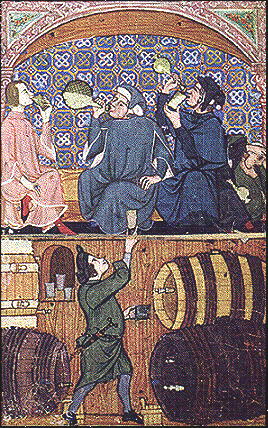 Commercially established taverns, on the other hand, were more likely to serve wine than beer or ale, and catered to the wealthy rather than the average commoner. Some had their own vineyard or were closely connected with one. Simple foods would be offered, but very rarely lodging. (Inns were an entirely separate establishment that served food and alcohol as well.) Over time, taverns were enlarged to include multiple rooms and a large storage cellar. Despite the upscale clientele of taverns, gambling and fighting were typical, as was prostitution and sometimes other criminal activity.
 Allison D. Reid