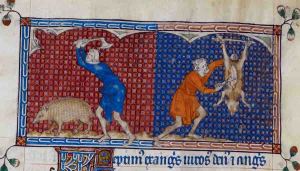
 The Anglo Saxons referred to November as the “blood month,” because it was time to begin slaughtering those animals which would not be kept through the winter. The traditional time for butchering animals was Martinmas (November 11th), though the butchering and processing of meat could continue through January depending on the weather. While some meat would be eaten fresh, it was important to have a supply of beef, pork, chevon (goat), and mutton (sheep) to last throughout the winter months. The preservation of meat was a laborious task. The flesh would have to be soaked in brine for days before it could be hung to dry and smoked. Meat might also be pickled, dried, or salted. Bacon in particular could be rubbed with spices and honey before it was smoked. Every part of the animal was used for something. The hides were used for making leather and parchment, hooves for gelatin, and bone and horns had a myriad of uses. Offal, blood, and bone marrow had to be eaten right away, and were turned into seasonal treats. Sausage and puddings were fall delicacies, providing a use for blood and organ meats. They were cooked with onions, garlic, and a variety of spices that made them especially tasty.
 When the fresh meat had run out, it was back to dried, salted meats, which weren’t especially nice to eat. Beef and mutton had to be simmered for a very long time to reduce the salt content enough to make them palatable. Bacon would be added directly to pottage, a thick stew that included vegetables, and grains like barley. Pottage was a staple food, often left cooking in a kettle over the fire for days on end, with the family simply adding water and ingredients to it as needed to keep it going.
Pork was the most popular preserved meat, especially for peasants. Pigs were easy to keep because they could forage for themselves, and after slaughter, their meat absorbed less of the preserving salt, helping it to retain more of its moisture. The leftover fat from slaughtering was used as lard, and also for the making of tallow candles. These would be vital to have for the dark, cold months ahead.
 Those pigs that weren’t being butchered (or at least not yet) were still being fattened in November. Acorns, beechnuts, hawes, hazelnuts, and other foods could still be actively foraged or collected for later feedings. But pigs weren’t the only ones out foraging for the last of nature’s bounty. Wild berries and apples, nuts, plums, and hips were great sources of nutrition—they just had to be collected. Coleworts (kohlrabi, cabbage, turnips) could also be harvested and stored someplace dark and cold. Sometimes they would simply be left in the ground and covered with a thick layer of straw. When needed, they could be uncovered, gathered, and eaten.
 November was also a time to collect reeds and osiers. These would be cured to use as thatch for roofs, or turned into baskets and nets for later use. Rushes became candle wicks, and nettles could be used instead of flax to make a durable thread. Bracken could be used as winter bedding for cattle. Firewood had to be collected as well, since much would be needed for heat and other purposes. There were restrictions, however. Dead wood could be gathered from the ground, or pruned from trees. People were not allowed to cut down live trees to use as firewood—this was a way to ensure that forested areas would continue to be a resource for many seasons to come.
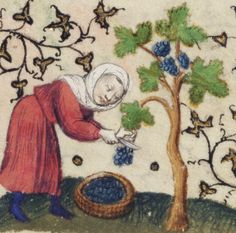 The last of the winter grains are being sown in the fallow fields, and grapes are still being harvested for the production of wine, and a common medieval condiment called verjuice; a clear, sour juice made from unripe grapes, apples, berries, or other fruit. It was used mainly for cooking and adding flavor to foods.
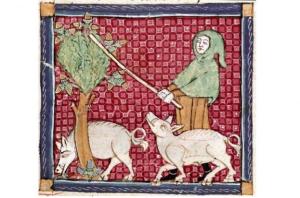 Pigs, a common sight in every village, were allowed to roam free and forage wherever they could year round. They were only semi-domesticated animals; lean and with coarse hair. They typically lived on what they could find, including scraps, and when well-fed in fall, quickly put on weight. It was said that “a pig that needed to be fed on grain was not worth keeping.” Since acorns were a favorite food of pigs, woods full of oak trees were especially prized for fattening them. Beechnuts, hazel nuts, and hawes were also favored by swineherds, who watched for the first signs that those trees were ready to drop. Poultry would be fattened as well, particularly geese, then slaughtered before they could lose their fat.
 Allison D. Reid