Weekly Fantasy Fix Black Friday Sale!

newsletter header

The Weekly Fantasy Fix Authors are having a Black Friday Sale!

Get discounts on our books all weekend long, plus a select number of books from other authors published through Crimson Edge Press. Check out this week’s special edition of the Weekly Fantasy Fix for deals and links.


Give the gift of reading for Christmas! Right now, my e-books are just 99 cents!

Want a paperback instead? Use promo code 992ES8RE to get 25% off all my printed books when you buy directly through the CreateSpace store.

Prices go back to normal next week, so don’t miss out!

$0.99
Get it Today!


$0.99
Get it Today!


Get your Weekly Fantasy Fix!

newsletter header


Writing for a Cause

Writers are a passionate bunch. We spend years of our lives dedicated to writing, re-writing, editing, re-editing, and marketing our stories, with little expectation of a significant financial return. We love it, even though at the end of the day most of us are probably making about two cents per hour! We write because we just can’t contain our imaginations, and the worlds and characters welling up inside us need a place to go. It gets unbearably crowded in there otherwise. Sometimes writing is our best form of self-expression, too, and through our stories we learn how to deal with our own internal conflicts.

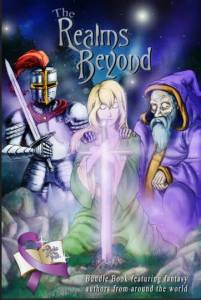
There are also times when we write for a greater cause—a meaning that extends beyond our creative passions and into the real world. For the past year, 10 writers have been working hard to put together a fantasy book called The Realms Beyond, hoping their stories will help raise money for the June E. Nylen Cancer Center in Sioux City, Iowa.

The project was envisioned by a young, upcoming author, KJ Hawkins, who had just lost her grandmother to pancreatic cancer. When I asked her how the idea for the book came together, she replied, “In many ways I felt like I needed to do this to help with my grief, but realized that my grammy would have wanted me to use what I was good at to leave a mark on the world. And I couldn’t think of anything better than to help those families fighting for their loved ones by putting together a book with the sole purpose of bringing them aid.”

When KJ Hawkins asked me if I’d be interested in participating, I was happy to say yes. My own grandfather died of pancreatic cancer, and other members of my family have been cancer survivors. I can imagine that all the participating authors share this connection in one way or another, and that many of the readers will too. Today pre-orders for the book have started, with the official release date scheduled for April 2017. It’s a project I’m thrilled to be a part of, and I hope that through it many lives will be touched in a positive way, readers and beneficiaries alike. Ten of us have come together to write for a cause—you can help too by reading for a cause. All of the proceeds from the book will go to the June E. Nylen Cancer Center.

realms-beyond-coverParticipating Authors and Included Works/Sub-Genres:
Allison D. Reid — Into the Shadow Wood (Christian Fantasy)
Ali Cross — Blood Crown (Sci-fi/New Adult)
Artemis Crow — Leona’s Descent (Fantasy)
D.B. Mauldin — The Chosen One (Young Adult/Fantasy)
Fiona Skye — Tools of the Dragon (High Fantasy)
KJ Hawkins — Half-Blood Academy Short Story Collection (Young Adult/Fantasy)
Melissa Barker-Simpson — Badge of Honor (Adventure/Fantasy)
Renee Scattergood — Makari’s Mission (Dark Fantasy)
Samantha Bryant — The Good Will Tour (Superhero/Fantasy)
V.L. Holt — 97 (Young Adult/Paranormal)


Click to Read the rest of this week’s Fantasy Fix newsletter.

Like what you see?  Subscribe to get each edition emailed directly to you.


Get your Weekly Fantasy Fix!

newsletter header


How To Craft A Terrifying Monster

As this year starts to wrap up, we see writing communities going WILD with NaNoWrimo, new publications, and attempting to prep for upcoming conferences, book conventions, and events in the upcoming year. I suspect many of you are involved in the madness that is November, enjoying the mayhem, while looking forward to the calm.

Are you a part of the shenanigans of November or are you missing out? Go out there and get comfortable in a writing group and feed off of the energy surging through the masses of authors. The three of us at the Weekly Fantasy Fix wish you much productivity in the coming weeks!

This quarter I wrote a column for the OWS Inked: Literary Journal on How To Craft A Terrifying Monster for your current manuscript…

Click to Read the rest of this week’s Fantasy Fix newsletter.

Like what you see?  Subscribe to get each edition emailed directly to you.


Get your Weekly Fantasy Fix!

newsletter header


Heroes and Villains

In a previous Inspiration Sunday post I mentioned that in the process of working out some things for the third book in my series, I’ve been thinking about the very different motives and actions of my heroes and villains. Where my story goes from here largely depends on their inner battles, and how those translate into actions that have world-wide consequences. What is each side trying to ultimately achieve, and in what ways are they trying to get there? Are they staying one step ahead of their enemies, or are they simply reacting as each new thing gets thrown at them, never really gaining any ground?

But even beyond that, what makes heroes and villains who they are is not just their inner conflict, but their inner character. The best heroes aren’t perfect people—they are just as flawed as the rest of us; sometimes more so. And yet what makes them different? Sure they might have special abilities—those can be squandered. They might be more desperate than most. Desperation can also turn to bitterness that produces nothing good. And we’ve seen time and time again how the same set of circumstances can turn one person to darkness and another to the light.

I found the answer in a quote from C.S. Lewis. “To love at all is to be vulnerable. Love anything and your heart will be wrung and possibly broken. If you want to make sure of keeping it intact you must give it to no one, not even an animal. Wrap it carefully round with hobbies and little luxuries; avoid all entanglements. Lock it up safe in the casket or coffin of your selfishness. But in that casket, safe, dark, motionless, airless, it will change. It will not be broken; it will become unbreakable, impenetrable, and irredeemable.”

Our heroes have to accept their flaws, allow themselves be deeply wounded by them, yet still have the strength rise to action…even when that action is self-sacrificial. They have to care about something larger than themselves, and to care, a heart capable of love is required. So where does that leave our darkest villains? By contrast, they are cold and selfish. Their flaws do not make them vulnerable to heartache—they won’t allow it. And while they might also care about something larger than themselves, it is only to the extent that they will greatly benefit in the process…and they have no problem sacrificing someone else to get their prize. They worship none but themselves. Over time, our villains’ hearts grow increasingly incapable of love until, to use Lewis’ words, they become unbreakable, impenetrable, and irredeemable. Those are the true villains that our heroes must rise against—the ones worth risking everything to defeat, because if they win, there will be nothing left worthy of living for.

For those of you who are writers, forget for a bit the mechanics of the plot you’re building, and look deep into the eyes of your heroes and villains. What lies hidden deep down in their hearts and souls? What, and who, do they really, honestly care about? How do their vulnerabilities impact their character, and what are they willing to do to achieve their goals? For all you who are readers, which heroes and villains stand out as the most memorable to you? What made them real?

Click to Read the rest of this week’s Fantasy Fix newsletter.

Like what you see?  Subscribe to get each edition emailed directly to you.


Get your Weekly Fantasy Fix!

newsletter header


Simple Writing Tips!

A couple weeks ago, we talked about NaNoWriMo starting on November 1st. Although I will not be personally joining a camp, I will be writing a significant amount of words during the month. Whether you have been writing for two years or two weeks, I wanted to include a few healthy reminders of what may help you be successful in your writing endeavors.

  • Start small. The important thing is to maintain a routine of writing every single day. 300 words per day is plenty. Did you know John Grisham began his writing career as a lawyer? He got up early every morning and wrote one page. You can do the same.
  • Have an outline. I am currently working on a webinar talking about important tips when writing. One large piece of writing is maintaining an outline. Think of your book in terms of beginning, middle, and end. Anything more complicated will get you lost. Highlight your plot points and break them down into major events.
  • Have a set time and place to work on your book every day. Schedule your time to work and your time to be off. When you are writing, you should be in a special space for writing, so when you enter it, your body is ready to tackle the manuscript. And don’t let yourself off the hook.

These are not entirely complex tips to follow, but even the best of writers forget the simplicity that keeps us on track. Now get out there if you are a writer, because you should be writing.

Joshua Robertson, CEO
Crimson Edge Press, LLC

Like what you see?  Subscribe to get each edition emailed directly to you.


Counting Down to FantasyCon! *correction*

If you didn’t read last week’s Fantasy Fix, you might not have heard the news–Renee Scattergood and I will both have booths during this online 8 day Facebook event celebrating Fantasy, Science Fiction, and Horror!

*You will be able to access my booth for this event starting tomorrow (October 9th) by going to the Epic Fantasy page of the event: https://www.facebook.com/events/518395788285240/

So please stop by to visit. I’ll be throwing out some trivia questions, offering e-book giveaways, sharing interesting tidbits about the Middle Ages (for all of my Medieval Monday fans), and of course, all of my book characters will be there for those who want to ask them questions. (Here’s your chance!)

Below is the FantasyCon schedule for the week. Be sure to check out all of the amazing authors, artists, bloggers, and more who will be making themselves available. This is my first time going, and I’m really excited to explore all there is to offer. It should be a fun week!

Sun 10/9 -Epic/Sword & Sorcery
Mon 10/10 -Sci-Fi/Time Travel
Tues 10/11 -Faiytale/Punk
Wed 10/12 -Paranormal/ Urban
Thurs 10/13 -Series/Short Stories
Fri 10/14 -Dystopian/ Apocolyptic
Sat 10/15 -Dark/Grim Dark/Horror
Sun 10/16 -Children/YA Fantasy

Get your Weekly Fantasy Fix!

newsletter header


Wibbly Wobbly Timey Wimey

World building is a time consuming process. There is a lot to take into account when you are considering every aspect of a new world…how it came to be, what kinds of people lived there, how its landscape, history, economy, religion, and politics developed over time to the point where your book plot begins. How is what you write going to shape that world’s future for any additional books you may be planning?

Part of building a new world is figuring out how time works. Is your brand new world governed by the same rules we’re already familiar with? Or is it more subjective and non-linear; “a big ball of wibbly wobbly timey wimey…stuff” as David Tennant (still the best Doctor!) describes time in Doctor Who? Do you mark the passage of time with minutes, hours, days, months, years? And are those at the same intervals we are accustomed to? Maybe you are doing something radically different. If so, how do you get your reader to let go of what they know and embrace your vision of how time moves?

When I started working on my series I ran into two issues which affected my perspective on time. First, even though my world is a complete fantasy, the setting mimics that of medieval Europe. I relied heavily on research to inform the details of what daily life would have been like. One thing I discovered is that while people of that era had the ability to keep time with mechanical clocks and other means, ordinary people simply didn’t bother. They didn’t even necessarily know their birthdays. They often had a general idea based on the season, but didn’t keep track of the specific date. They might mark certain years based on memorable events, like the year the river flooded, or lightning struck the bell tower. Religious days and festivals were more regimented, but by the Church, which was more exact with its time keeping.

For most, the days were governed by the position of the sun, and the passage of time by the seasons and the demands required by them in turn. I’ve tried to express this different sense of time through the eyes of my characters—hopefully I have been successful. I also purposely did not give my characters specific ages. I have a general idea of how old they are, and so do they. But they won’t be celebrating any birthdays.

Second, our present day calendar and numeric way of tracking the passage of years is unique to our history. It occurred to me that in my world, their way of keeping time should be unique to theirs. Trying to track years with numbers quickly became too complicated, especially since I created a historic timeline that started way back at the very creation of my world.

I decided instead to split my world up into different eras, their names determined by a special group of prophets within the monastic community. Each era of time has its own important events, and its own feel, much like the decades of the 20th century. The 60’s had a very different feel from the 80’s. The names given to each era describe their significance in history, starting with the Era of the Ancients, the very first era in which the world was created and humanity made its appearance. Later on the Era of Desolation marked a period of great turmoil and suffering, followed by the Era of Varol, where my world’s greatest hero (Varol) emerges to change the course of history. A listing of all the eras and their significance was included as supplemental material when I published Ancient Voices: Into the Depths.

If you’re a fantasy or sci-fi writer, how do you mark time in your world? If you’re a reader, what are some of the most interesting ways your favorite authors have played with the concept of time in theirs?


Click to Read the rest of this week’s Fantasy Fix newsletter.
Like what you see?  Subscribe to get each edition emailed directly to you.