“Now in autumn, in which the fruits of the earth are assembled, is the time of reaping and of the vintage, and it signifies the time of the General Judgment, when every single person will receive the reward for his works.” – Hrabanus Maurus (9th Century Theologian)
Summer is nearing its end—can you feel it? For some of us the nights are finally getting cooler, and the birds are just starting to gather and circle in large numbers. With children going back to school, our routines have changed, and we’re already feeling some anticipation about upcoming autumn activities and holidays.
 Medieval people had a heightened awareness of seasonal changes. The onset of autumn brought about a final burst of activity as they prepared themselves to endure an inevitable winter. The grain harvest that had begun in summer continued into fall, with threshing and winnowing of what had already been reaped from the fields. At the same time legumes, such as peas and beans, were gathered after they had dried on the plants. Never letting anything go to waste, the leftover leaves and stems could be used to feed the animals, or plowed under as fertilizer. Some fields would be plowed anew with seeds for rye and winter wheat.
Another significant labor for September was harvesting grapes for wine making. Because of the amount of land needed, and the extensive labor involved in both cultivating and working vineyards, they were usually only kept on large estates or monasteries. Wine was incredibly important in medieval society. It was consumed by most classes with meals, but also had medicinal uses, and spiritual significance as part of the Eucharist.
 New wine was the most common drink, which had very limited alcohol content. But stronger wines were also produced, and could be watered down if needed. There were many more variations in taste, smell, and color than people are accustomed to today. Wines might be red, gold, pink, green, white, or such a dark red that it had a black appearance. There was also a variety of flavor–some were pleasant and sweet (usually reserved for special occasions), where others might be more bitter, or even vinegary.
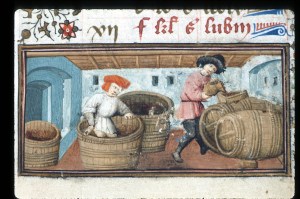 Sometimes the type of wine chosen was dependent on the season (and which bodily humors were at play), on age, or on the state of one’s health. Melancholy was thought to be the dominant humour in autumn, which was “cold and dry.” The Secretum Secretorum advocated specific foods, drink, and activities to combat the negative effects. “Hot moist foods like chicken, lamb and sweet grapes should be eaten and fine old wines drunk, to ward of melancholy…Overmuch exercise and lovemaking are not recommended…but the heat and moisture of warm baths are helpful in keeping melancholy under control.”
 Other labors of September included gathering honey and wax from beehives, which would then be moved to suitable locations for winter. Cows would be bred to ensure there would be young calves in the spring. Any cattle, or other livestock, that there were not enough resources to feed through the winter would be sold or butchered for meat. The meat would then be salted, smoked, or otherwise preserved in anticipation of the winter to come. At the end of September, on Michaelmas, lords and other debtors collected their rents and payments.
In this month’s Tales from the Green Valley, learn about plowing with oxen, sowing seeds, harrowing, baking bread, period clothing, caring for pigs, and making period food (pigeon, apple fritters, mushrooms).
Learn more about life in the Middle Ages by checking out the Medieval Monday Index.
 Winter had tightened its grip, and the most important labor of January was staying warm! With only hearth fires for heat, the cold was a very real danger for everyone, but especially the young, the elderly, and the poor. There were still several feasting days to be celebrated, which continued to be a blessing for those who needed help getting through winter. January 6th, the day after Epiphany, was the Feast of the Three Kings. Christian tradition was often blended with agricultural ceremonies rooted in pagan tradition, even though the Church frowned on these practices. The plow and distaff, symbols of male and female societal roles, were both honored. There might be plow races, or processions though villages. The plows might also be pulled around a bonfire to bring good luck for the new year. Actual plowing could not begin until after Candlemas (February 2nd) which was the Feast of the Purification of the Virgin Mary. At that point, the winter respite from the fields was officially over, and they were tilled in preparation for spring planting.
 There were other things to do during the month of January. On the coldest days, medieval people completed any type of work that could be done indoors. Spinning thread, weaving, repairing hunting and fishing nets, making utensils, and repairing or sharpening tools were among them. With spring not so far into the future, all the necessary farming equipment would need to be in working order. On milder days, people could do some outdoor work, such as gathering firewood, mending fences, pruning vines, or using a hoe to harvest clay from riverbanks.
 In the cold days of December, the fields were finally quiet, with the ground too frozen to work. Animals were taken care of, to ensure they would not only survive the harsh months to come, but that they would be healthy on spring’s arrival. After all, they would be needed to work. In bad weather, animals would need to be brought indoors and fed straw mixed with other nutrients such as corn stubble, or pea pods. Other outdoor work consisted of mostly repair and reconstruction. Timber was cut, and fences and walls mended. If autumn rains had eroded the banks of the mill pond, they would need to be fixed as well.
 Allison D. Reid