Fantasy Art Friday

Wednesday got busy this week, so I moved this post to Friday. Get inspired with this week’s Fantasy Art Friday, where fun fantasy artwork is combined with a writing prompt to get your creative juices flowing.


Rising up from the ruins are two formidable stone guardians. Ruined or not, this place is fiercely protected. The bears stare down the lone figure approaching. His bow and arrows are no threat–they might as well be toys.

The man carefully contemplates his approach, as well he should. Must a certain ritual be followed to pay the proper respect? Will he be accepted and sheltered here, or will the guardians see him as a threat? This place may be a sanctuary, but whose sanctuary is it?

“Sanctuary” by Juan Pablo Roldan

Fantasy Art Wednesday

I know I haven’t posted one of these in a while. My schedule has been pretty busy, and my blog has been sparse as a result. I promise I’m trying to get back on schedule, though! Here’s this week’s Fantasy Art Wednesday, where fun fantasy artwork is combined with a writing prompt to get your creative juices flowing.

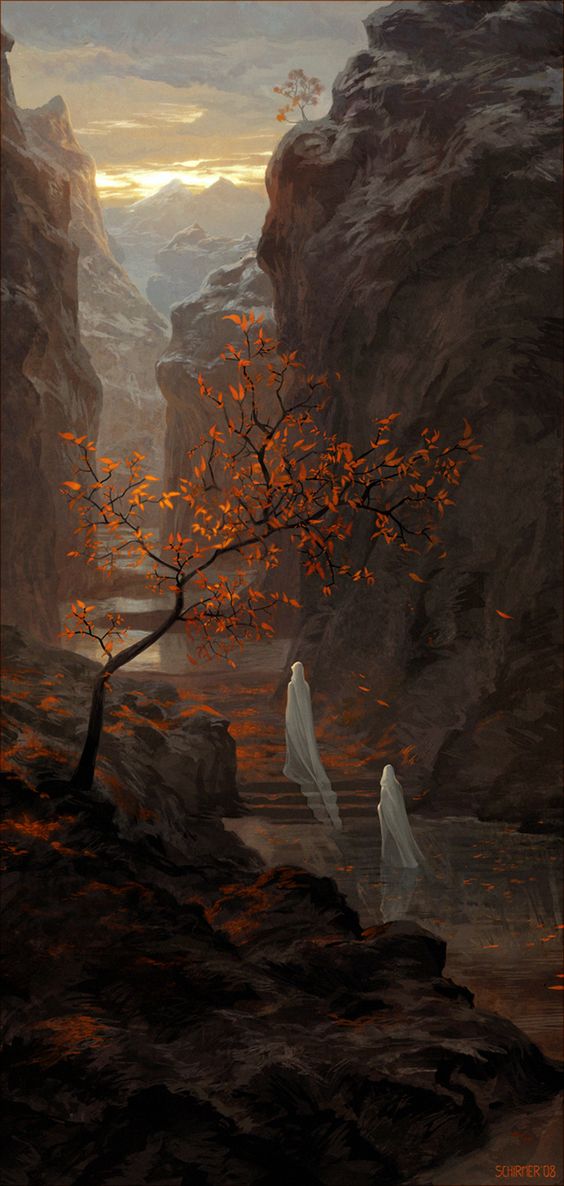
Two ethereal figures emerge from a pool of still water. Slow and solemn, they seem to be more of the spirit world than the one of solid stone they are now traversing. Where have they come from, and where are they going? Is there a secret world hidden beneath the murky water? Or is this pair part of a ghostly legend, their appearance coinciding with a certain date, or time of day? If you blink, will they disappear, leaving no trace that they were ever here?


Fantasy Art Wednesday

Get inspired with this week’s Fantasy Art Wednesday, where fun fantasy artwork is combined with a writing prompt to get your creative juices flowing.


I love ruins, and I love arches–they are full of mystery, and beauty. You can’t help but wonder where they lead…what was once surrounding them. The old stones tell stories of their own. This image I found particularly beautiful. Someone added a note to it–I have no idea if it was the artist or someone else. It said, “I stand within the portal of my dreams and I must not fear what is to be…it will be even if I wish for it to be different…more to my liking…but I may not know what I really need.”  

What if this archway is not simply the remains of an old structure, but a portal of dreams. Step through and dare to seek them, prepared to face whatever lies on the other side. Our dreams, even when achieved, never quite come out the way we expect, do they? There is always some twist, some unanticipated pleasure or consequence we could not foresee. There is as much risk in following them as there is standing still.

Dare to approach this old crumbling archway, though it may be more than it seems. Will you step into it or walk away? What dreams would you carry with you to the other side? Will they lift you beyond your own vision to be something greater? Or will they twist and change into something completely unexpected? Once through, will there be a way to return, or does the dream, in whatever form it takes, become unchangeable reality that you cannot escape?

Old Ruins by Ninjatic

Liebster Award!

Adam at Write Thoughts nominated me for a Liebster Award last week! I was quite surprised and honored that he thought of my blog. Thank you again, Adam–I know you’ve been waiting to see the answers to your questions, and I’m sorry it took so long. But first I’d best share what the rules are for everyone else reading this post, and for those I’ve nominated in turn (the list is at the bottom of the page).

– Say thank you to the person who has nominated you for the award.
– Answer the 11 questions the person has asked you.
– Nominate 11 people (comment on their blog to let them know).
– Ask the people you have nominated 11 questions

Adam’s questions to me:

1. What is your favorite book, or if you prefer, your favorite author?

My favorite author is C.S. Lewis—not just for the Chronicles of Narnia, which are dear to my heart, but for the entire breadth of his writing. The more I get to know his body of work, the more he amazes me.

2. Is there a country you have always wanted to visit, if so where?

Ireland! You’d think I would have gotten there while I was living in Germany, but I never made it that far. It is still on my “someday” list.

3. What do you enjoy about blogging?

Connecting with other authors and readers. My blog also gives me a chance to express interests not specifically related to my books.

4. What’s your preferred writing space?

My desk, boring as that is. More important than the space is the atmosphere though. I need a quiet place to write, with soft lighting and no distractions. I have to be able to mentally leave this world and enter another one, so anything that continually pulls me back into reality hinders my progress.

5. How do you find inspiration?

I find inspiration in lots of places: my medieval history research, old myths and legends, the Bible, out in nature, and sometimes in the faces of strangers. My starting inspiration for my current book series was an online medieval roleplaying game and all the characters and stories that came out of it. I have a pretty active imagination, so it doesn’t take much of a spark to set it off.

6. What do you like to do for fun when you need a break from writing?

Writing-related research, building cool stuff in Minecraft with my family, playing with our pets, reading, yoga, and going to our local sports club for some much needed time on the exercise machines or in the pool. (I’ve got to get out of that desk chair sometime!)

7. What started you down the road of writing?

I’m not sure—I have been putting creative words to paper since I first learned how to write a sentence back in first grade. There have certainly been people who have encouraged me along the way, and shaped who I am as a writer, but I think writing is just part of who I am.

8. What’s one story you keep recommending to others?

There isn’t really one story that I recommend. If I do this at all, it is when I know a particular book will resonate with the person I’m talking to.

9. How do you keep yourself motivated?

The stories running through my head are motivating enough. Once the ideas start coming together into a cohesive plot, I just have to get them out in written form.

10. What superpower would you choose and why?

I would want the power to move through time, with no ability to interfere—just to observe. I would finally get to experience the daily life of another era; something historians can only guess at. I’d be able to write some really amazing Medieval Monday posts! It would be pretty awesome to go back and visit my ancestors too. Forget digging through old land deeds, obituaries, and marriage licenses. I’d find out who they really were, the good and bad alike, and see where they came from with my own eyes.

11. What four people would you invite to a dinner party; contemporary, historical, or fictional?

I would go to the Eagle and Child and sit down with the Inklings for an evening. I’d be completely intimidated by all of them, of course, and I doubt they would think much of my writing, but it would be a dream come true to just be in their company.

Now here are my nominations for the Liebster Award! (In no particular order):

Into the Writer Lea – Andrea Lundgren
Literature and Lamp Posts – David Wiley
Books and Beverages – Jamie Lapeyrolerie
Lee Duigon
Renee Writes – Renee Scattergood
Robertson Writes – Joshua Robertson
Chris the Story Reading Ape – Chris Graham
Frederick Anderson
Blonde Write More – Lucy Mitchell
Smorgasbord – Variety is the Spice of Life – Sally G. Cronin Stories of Adventure and Friendship – Duri Rolvsson

And since I’ve taken a week to get this far, I am going to cheat a little and ask my nominees many of the same questions I was asked (with a few differences). They were great questions, and I’m interested to see how your answers compare with mine anyway! 🙂  Have fun!

1. What is your favorite book, or if you prefer, your favorite author?
2. Is there a country you have always wanted to visit, if so where?

3. What do you enjoy about blogging, and how has your blog changed in unexpected ways since you started it?

4. What’s your preferred writing and/or blogging space?

5. How do you find inspiration?

6. What do you like to do for fun when you need a break from writing (or from your blog)?

7. What started you down the road of writing and/or blogging?

8. Are there any Indie authors you would recommend to readers looking for a good book?

9. How do you keep yourself motivated?

10. What superpower would you choose and why?

11. What four people would you invite to a dinner party; contemporary, historical, or fictional?


Fantasy Art Wednesday

Get inspired with this week’s Fantasy Art Wednesday, where fun fantasy artwork is combined with a writing prompt to get your creative juices flowing.


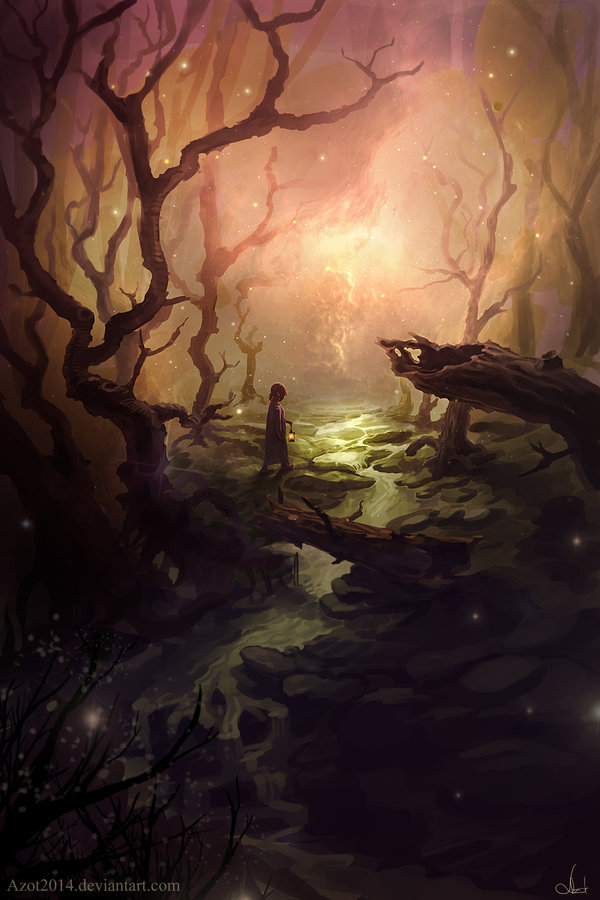
A very striking image with a curious title of “Narnia.” It’s no secret that the Chronicles of Narnia are dear to my heart. This would appear to be Lucy, but the specific scene is not one I recognize from the books themselves. On first impression this seems like a scary and dangerous place–the trees are angular and bare of foliage, maybe even dead. Is the forest ablaze? But that feeling of alarm is offset by those glowing, magical orbs and the fact that Lucy walks through, seemingly unconcerned. So what IS going on in this image? Without knowing the artist’s intent, perhaps that intense glow is Aslan with a mane of holy fire, returning to a world still broken and ruled by the White Witch. Narnia fans, what do you think?

The title, and all Narnia references aside, there is plenty of intrigue in this image to feed a writer’s muse. Delve into its mysteries and come up with your own interpretation of what is happening; who the little girl is, and what sort of world she is wandering through alone, in nothing but her night clothes, and carrying a single lantern for light.  

“Narnia” by Azot

Fantasy Art Wednesday

Get inspired with this week’s Fantasy Art Wednesday, where fun fantasy artwork is combined with a writing prompt to get your creative juices flowing.


This curious image caught my attention for today’s post. I sense no danger in the peaceful, sun drenched glade. It seems to be a place of seclusion, of meditation. I can imagine that some wise sage lives in that shabby little house built up in the tree. It has obviously been there for many years, perhaps even many ages. Is the figure in red the sage himself? Or perhaps a sentry who ensures that he can meditate in peace without being disturbed at inopportune times by those who come to seek out his wisdom.

But this is only my initial impression. Who do you think lives in this moss and vine covered tree? 

Title and Artist Unknown


Five Tips for Writing Good Dialogue

Throwback Thursday! I thought it might be fun to resurrect this post from my other blog two years ago this month!


Five Tips for Writing Good Dialogue
Many writers struggle with dialogue, maybe because there is so much pressure to get it right. Speaking in someone else’s voice isn’t always easy, yet as writers we end up with a whole cast of characters who all need distinct, unique voices, and it is up to us to provide them. Who would want to read a book where all the characters sound the same? Boring…and confusing.

But creating our characters’ voices is only the beginning—they still need something authentic and interesting to say, not to mention the writing itself must have all the correct grammar and punctuation.

I thought this week I might share some tips for writing dialogue, and anyone who wants to add their own in the comments section is welcome. No, I am not an expert. These are based on my own experience as a writer/editor, and on advice I have received from others over the years. I am still learning and improving, and frequently need to go through and re-examine my own dialogue when I am editing.

Tip 1 – Finding your character’s voice.

As I mentioned earlier, the last thing you want is for all of your characters to sound the same. Even people growing up in the same household will vary in their speech patterns. An outgoing person might have the tendency to talk a lot, while a more reserved person may say very little at all. Knowing your characters well is vital to writing good dialogue. What are their personalities and thought processes? What would they say, and how would they say it? Would they use big words or simple ones, formal speech or slang? Does she talk faster when excited? Does he deliberate over every word? Do they live in a region with a dialect? All things to consider. A good test is to strip away the identifiers in a section of dialogue. Can you still tell who is speaking, just from the way the words are spoken?

Tip 2 – How much realism is necessary?

I took a writing class once where we had an unusual assignment to help us learn about dialogue; go sit in a public place and listen in on the surrounding conversations.   We were supposed to return with our observations about how people naturally speak to each other. Several things stood out for me.

  1. People rarely give direct, simple answers to a question. They tend to dance around it and give explanations rather than just say yes or no.
  2. They easily tangent from subject to subject, sometimes having multiple conversations simultaneously. They might eventually circle back to the original topic, or never resolve it at all.
  3. There tend to be lots of extra pauses, ummm’s, uh’s, like’s, and external interruptions.

Does all of this really belong in a story?  Probably not, especially the latter two.

While the point of that assignment might have been learning how to re-create realistic conversation, I think for me it was a lesson in how not to write dialogue. When it comes to what our characters do, we don’t think twice about skipping over all the mundane parts of the daily routine. No one wants to follow their characters to the bathroom ten times a day, or watch them cruise around the grocery store checking package labels—unless there is a point to doing so. Why should dialogue be any different? If it does not enhance our character’s development or further the plot in some way, it doesn’t belong. Make every spoken word count so that it has purpose and meaning, otherwise it is just taking up valuable real estate.

Tip 3 – What about special speech?

Regional dialects, “thee and thou,” historical, and traditional fantasy dialogue are all under this category. My advice is to proceed carefully. It is usually better to give the occasional flavor of a dialect than try to replicate the whole thing, especially if you do not speak in that dialect yourself. It won’t sound authentic, and you’re bound to make mistakes. Writing in dialect can get very tedious for the writer and hard to understand for the reader. Choosing a selection of words that will make it obvious where the speaker is from, and using them consistently, can be quite effective.

Thee and thou I wouldn’t use at all in a long piece, unless you know you can authentically pull it off and the story absolutely needs it. Most writers don’t get the grammar right consistently and it just doesn’t work. Readers also tire of it pretty quickly.

Historic and fantasy-specific language is pretty well accepted. Readers of these genres are quite comfortable with the tradition and actually expect the use of older words and more formal, elegant speech.

What they are not as likely to forgive is language that will pull them out of whatever era they have settled into. Don’t use modern sounding words, or worse yet, metaphors or sayings that refer to things that would not have even existed yet. This is where an online dictionary can be your best friend. Yes, you already know what a given word means, but scroll down to see the word’s origin, or etymology. You can find out where the word came from, and when it came into use. If you’re writing a medieval era story for example, don’t use words that didn’t come into use until the 1700’s or later. It will greatly annoy your more savvy readers and make you look like an amateur.

Tip 4 – What comes after the quote?

One of the most difficult parts of writing dialogue can be knowing what to say after the quotation marks are closed. There are lots of different opinions out there, and I can’t say that I agree with all of them. He said, she said—pretty standard. Some advocate that you shouldn’t use much else, that the reader will just tune it out after a while and focus only on the dialogue itself. Others say varying it up strengthens the writing; he stated, she replied, they inquired, etc.

Both camps are pretty adamant, but I think this is one of those areas where writers have some leeway. Neither is technically right or wrong—it is just a matter of personal taste and writing style. I tend to vary it up because as a writer I get bored with just he said, she said. And sometimes including some extra descriptive words (yes, even those controversial words ending in “ly”) help me convey the emotions and facial expressions of the speaker.

That being said, be careful of ending your dialogue with phrases like, he laughed. Try to laugh an entire sentence sometime and let me know how that works out. It is more correct to say something like, he said as he laughed. The difference may seem subtle, but grammatically there is a difference. Also, be aware of whether your character is making a statement or asking a question. If there is a question mark at the end of the sentence, use he asked rather than he said, and vice versa.

Tip 5 – Commas, and periods, and quotation marks, oh my!
Quotation Rules


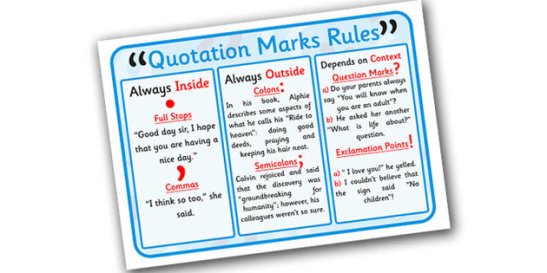
Yeah, this is grammar, and I’m sorry. But as an editor, it makes me crazy when writers don’t know how to correctly punctuate their dialogue. If you are an American writer, please keep your periods and commas inside the quotation marks. “Yep, just like this,” she said. “Not like this”. Also note that I did not write, “Yep, just like this.” She said. She said is not a sentence by itself.

If someone in your story is speaking for a long time, requiring more than one paragraph of dialogue, do not end each paragraph with closing quotation marks. However, every time you start a new paragraph, begin it with quotation marks. The reader will understand your character is still speaking. Reserve your ending quotation marks for the end of the very last paragraph of the dialogue.

Quotation marks can also be confusing when someone who is already speaking quotes another person. For instance, My grandmother always used to say, ‘cheaters never win, and winners never cheat.’ The regular double quotes are for the person speaking, while the information being quoted is enclosed in single quotation marks. Make sure that you have both beginning and ending quotation marks for each.

Quotation marks should be reserved for spoken words only. Inner thoughts written as dialogue should always be in italics. That guy is crazy, she thought.

Lastly, check to make sure all your quotation marks face the right way. When typing things for the first time, your word processing program will position them correctly. But once you start editing, cutting, pasting, inserting, and moving text around, sometimes they can get turned the wrong way. It is easy not to notice unless you are looking, so make this part of your self-editing process. It is way easier to fix these issues as you go, rather than having to find and correct them in an entire manuscript after the fact.

These are just a few of my thoughts on writing dialogue. What makes good dialogue for you as a writer or reader? What makes the story stronger, and what makes you want to stop reading? How can you let what others have done inform your own writing to make it better?