This fun, well-thought-out article by Max Gladstone finally settles the debate that my household engages in every year…or does it? I’m firmly in the Halloween movie camp–I mean, really, it’s about Jack losing passion for his role as the Pumpkin King, trying to be something he’s not, and subsequently finding himself–and his love for Halloween–all over again. But my husband is firmly in the Christmas move camp for reasons of his own. Whichever camp you’re in, this is a brilliant article on the topic and well worth reading. Who would have thought a claymation movie would inspire such deep, philosophical debate? Well, it is a Tim Burton creation after all, and not exactly your typical kid’s film. If by some chance you have missed this movie in the last 25 years, go rent it. Right now! Then come back to this article and see what you think. Halloween movie or Christmas movie? Maybe it’s both…

Is The Nightmare Before Christmas a Halloween movie, or a Christmas movie? In terms of worldbuilding, it’s obviously both—it’s about a bunch of Halloween-town residents taking over Christmas from Santa Claus.
But worldbuilding elements don’t suffice as genre classifiers, or else black comedies wouldn’t exist. Creators deliberately apply worldbuilding elements from one genre to another for pure frission’s sake. Consider Kiss Kiss Bang Bang (speaking of Christmas movies), which takes a New York noir character, a down-on-his-luck con, and drops him into an LA noir scenario of movie glitz and private eyes; or Rian Johnson’s amazing Brick, a noir story engine driving high school characters. Fantasy literature is rife with this sort of behavior—consider Steven Brust’s use of crime drama story in the Vlad Taltos books, or for that matter the tug of war between detective fiction and fantasy that propels considerable swaths of urban fantasy. If we classify stories solely by the worldbuilding elements they contain, we’re engaging in the same fallacy as the Certain Kind of Book Review that blithely dismisses all science fiction as “those books with rockets.”
And what happens after the slippery slope? The No True Scotsman Argument?!
This is a frivolous question, sure, like some of the best. But even frivolous questions have a serious edge: holidays are ritual times, and stories are our oldest rituals. The stories we tell around a holiday name that holiday: I’ve failed at every Christmas on which I don’t watch the Charlie Brown Christmas Special. When December rolls around, even unchurched folk can get their teeth out for a Lessons & Carols service.
So let’s abandon trappings and turn to deep structures of story. Does The Nightmare Before Christmas work as Christmas movies do? Does it work as Halloween movies do? It can achieve both ends, clearly—much as a comedy can be romantic, or a thriller funny. But to resolve our dilemma we must first identify these deep structures.
Halloween Movies
Halloween movies are difficult to classify, because two types of movie demand inclusion: movies specifically featuring the holiday, like Hocus Pocus or even E.T., and horror movies, like Cabin in the Woods, The Craft, or The Devil’s Advocate. Yet some horror movies feel definitely wrong for Halloween—Alien, for example. Where do we draw the line?
I suggest that movies centering on Halloween tend to be stories about the experimentation with, and confirmation of, identities. Consider, for example, It’s the Great Pumpkin, Charlie Brown, which might at first glance be mistaken for a simple slice of life featuring the Peanuts characters’ adventures on Halloween. In fact, the story hinges on the extent to which the various Peanuts’ identities shine through the roles they assume. Charlie Brown is the Charlie Browniest ghost in history; a dust cloud surrounds Pig Pen’s spirit. Snoopy operates, as always, in a liminal space between fantasy and reality—he becomes the most Snoopy-like of WWI fighter aces. Linus, whose idealism and hope are the salvation centerpiece of A Charlie Brown Christmas, isn’t equipped for the kind of identity play the other characters attempt. He’s too sincere for masks, and as a result becomes the engine of conflict in the story. For Linus, every holiday must be a grand statement of ideals and hope. In a way, Linus is rewarded—he meets the Avatar of Halloween in Snoopy’s form, but fails to appreciate the message sent, which is that Halloween is an opportunity for play, for self-abandonment. It’s Lucy who turns out to be the truest embodiment of the holiday—by explicitly donning her witch mask, she’s able to remove it, and bring her brother home.
Even movies that feature Halloween in passing use it to highlight or subvert their characters’ identities by exploiting the double nature of the Halloween costume: it conceals the wearer’s identity and reveals her character at once. In E.T.’s brief Halloween sequence, for example, while Elliott’s costume is bare-bones, Michael, Mary, and E.T. himself all shine through their costume selections, literally in the case of E.T. The Karate Kid’s Halloween sequence highlights Danny’s introversion (he’s literally surrounded by a shower curtain!) and the Cobra Kai’s inhumanity (skeletons with all their faces painted identically!). Even holiday movies like Hocus Pocus that aren’t principally concerned with costuming present Halloween as a special night for which identities grow flexible: the dead can be living, the living dead, and a cat can be a three-hundred-year-old man.
If we expand our focus to include books that focus or foreground Halloween, we find Zelazny’s A Night in the Lonesome October, Raskin’s The Westing Game, and Bradbury’s Something Wicked This Way Comes, all of which focus on the experimentation with, or explicit concealment of, identities, and the power of revelation. Fan artists get in on the fun too—every time Halloween rolls around, I look forward to sequences like this, of characters from one medium dressed up as characters from another.
The centrality of identity play to the holiday explains why some horror movies feel “Halloween-y” while others don’t. Alien, for example, is a terrifying movie, one of my favorites, but with one notable exception it doesn’t care about masquerades. Cabin in the Woods, on the other hand, feels very Halloween, though it’s less scary than Alien—due, I think, to its focus on central characters’ performance of, or deviation from, the identities they’ve been assigned.
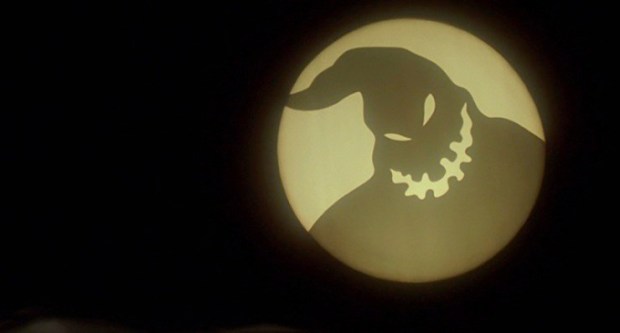
Examined in this light, The Nightmare Before Christmas is absolutely a Halloween movie. The entire film’s concerned with the construction and interrogation of identity, from the opening number in which each citizen of Halloween Town assumes center stage and assumes an identity (“I am the shadow on the moon at night!”), to Jack’s final reclamation of himself—“I am the Pumpkin King!”
So, are we done?
Not hardly.
Continue reading this article: https://www.tor.com/2018/10/26/is-the-nightmare-before-christmas-a-halloween-movie-or-a-christmas-movie/
Christmas Movies

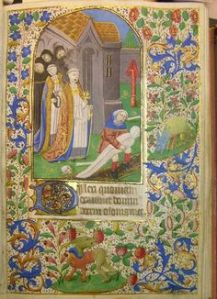 From All Saints Day, the transition was made to All Souls Day on November 2nd. Again, there was feasting, but the focus shifted from the martyrs and saints to ALL of the faithful departed. Death was a very central theme of medieval life, which was always full of uncertainty. The child mortality rate is estimated to have been somewhere between 30-50%. Conditions were highly unsanitary as there was no understanding of germs, nor of their direct connection to disease. As such, medicines were largely ineffective, and most injuries and diseases could not be properly treated. Any minor ailment (by our standards) could end in death. The additional risks of famine and war were all too real, and public punishments were often physically brutal. It is no wonder that the medieval mind was so fixated on what would happen beyond death, and beliefs on the subject shaped the attitudes and culture of everyday life.
 Halloween
 Some of our current Halloween traditions have their roots in the Middle Ages. People would dress in costumes intended to scare away any dark spirits that happened to be wandering about. Bells were rung, and there were processions and bonfires to scare away witches, ghosts, and evil spirits. Children and the poor went door to door, offering prayers for the household’s deceased relatives in exchange for small “soul” cakes.
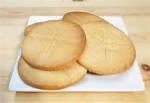 The video I included today is by Claire Ridgway, founder of TheAnneBoleynFiles and the Tudor Society. She demonstrates how to make “Soul Cakes” using a traditional Tudor recipe (which she reads from so you can hear the original version). If you’re feeling adventurous in the kitchen this week, or want to bring something interesting to that Halloween party you’ve been invited to, give it a shot!
 Allison D. Reid